
How Arrest Warrants Work in Berkeley County
Arrest paperwork in Berkeley County starts with the Magistrate. South Carolina Code section 22-5-110 gives that court authority over arrest and preliminary criminal matters. No public source lists a county queue of pending requests. A judge's decision in one case cannot be predicted from outside, and the public sources do not try. The court paper itself names the issuing jurisdiction and the case. From there, records split by court. The Clerk of Court keeps General Sessions and Family Court files, while a Magistrate clerk or a city Municipal Court keeps its own. The Sheriff's Judicial Services Division serves criminal, Family Court, General Sessions, and Magistrate process. South Carolina Code section 22-5-110 spells out the Magistrate's process roles, so ask whichever office holds the record which step applies.
Berkeley County Courtesy Summons Rules
Section 22-5-110(B) draws a line between two kinds of requests. A law-enforcement officer asks for a warrant one way. A private affiant follows another. In that second case, the Berkeley County court may issue a courtesy summons instead. Miss the date, and an arrest warrant can follow under the statutory conditions. That is the legal path, not a conclusion about any one case. A summons and a warrant are different papers. If a notice arrived or a date was missed, call the issuing court and ask what was entered, because an online case listing will not show every event.
Arrest Warrants: What They Contain
Official forms share a common layout. You will find the court and county, a case or docket number, the charge, judicial approval, the command to an officer, and service or return details. A Family Court arrest form also points to an underlying order and any amounts due. A blank form shows structure only. It gives no current bond figure and no sample of a live case. Some fields are sensitive. South Carolina forms can carry addresses, birth dates, driver's-license data, Social Security numbers, and physical descriptors. A Berkeley County page can describe those field categories without copying values from a real record.
| Issuing court | Shows which clerk can answer case questions. |
|---|---|
| Case and charge | Links the process to the underlying court matter. |
| Officer command | States the authorized action. |
| Return of service | Records what the officer reported to court. |
| Bond field | May appear on a form; confirm any current condition with the court. |
Berkeley County Sheriff Service Roles
The Berkeley County Sheriff's Judicial Services Division runs a Warrants Unit. It serves criminal arrest, check, Family Court, General Sessions, and Magistrate bench warrants. Municipal police handle their own court papers. The clerk keeps the court-side file. A detention center processes custody or release when someone is held. These jobs overlap in one case. They are not interchangeable. The Sheriff can serve an order without being the office that can recall it. Hill-Finklea answers booking questions, but the issuing court still makes the call.
Judicial Services Division
Berkeley County Sheriff's Office
223 North Live Oak Drive, Moncks Corner
843-719-4465
How Warrants Get Served in Berkeley County
Once a court issues an arrest warrant, the responsible agency may enter, validate, and serve the paper through law-enforcement systems. Berkeley County Sheriff Technical and Support staff describe NCIC inquiry, entry, removal, and validation by certified personnel. That work happens inside law enforcement. It is not a public search tool. After service, the officer returns the information to the issuing court. Sheriff deputies, municipal police, and federal officers may each play a distinct role. Public Index can show case context without listing every service event. Ask the issuing clerk and the responsible serving agency what each one can confirm for your case.
Arrest Warrants, Summonses, and Bench Warrants
Each paper does a different job. An arrest warrant authorizes custody under the court's process. A courtesy summons gives notice under statutory conditions. A bench warrant follows a missed appearance, a trial in absentia, or another court order. The official South Carolina forms keep these paths separate. Naming the right one helps a Berkeley County clerk pull the record and explain the next step. For a bench-warrant question, go to the issuing court rather than a general arrest-warrant label. A search warrant is different again. It targets identified property or a place, rests on a probable-cause affidavit and a return, and is not a public wanted-person list.
| Record | Purpose | Where to ask |
|---|---|---|
| Arrest warrant | Authorized custody process | Issuing court and serving agency |
| Summons | Notice to appear | Court named on notice |
| Bench warrant | Court appearance or order process | Issuing clerk |
| Search warrant | Search and seizure under terms | Issuing authority, subject to access limits |
Rule 3 Moves Some Berkeley County Records
South Carolina Criminal Rule 3 shifts some Berkeley County records as a case moves. Authorized officials transmit arrest-warrant and bond documents for General Sessions matters to the Clerk. The Clerk forwards them to the solicitor for a stated disposition or extension. That is why lower-court paperwork can land in a different record chain. The rule describes a court-to-court flow. It is not a public real-time warrant feed. A record may sit with the issuing lower court, the Clerk, a serving agency, or another office at any stage, so confirm the current holder with the court named on the papers. Read South Carolina Criminal Rule 3 for the official filing path.
Family Court Forms Have Separate Fields
SCCA412 and SCCA412A are the Family Court arrest-warrant and affidavit forms. Each form reflects an underlying order. Support categories and other amounts due come first. Then come the affidavit, judicial action, arrest instructions, bond or payment-for-release fields, service, and return, a structure unlike a General Sessions arrest or a Magistrate's criminal warrant. Family Court details can be confidential. Keep the forms' personal information off any public post. Call Berkeley County Family Court or the Clerk at 843-719-4500 for its own records route.
Berkeley County Arrest Warrant Next Steps
Start by naming the court and the case. Ask the clerk whether a current entry exists. Ask whether you must appear, file a motion, surrender, or post bond, and how the court will confirm any action it takes. A lawyer can advise on the options that fit the specific matter. Berkeley County has no universal walk-in rule or countywide bond schedule. A payment alone may not recall a warrant. Custody can carry other holds too, so confirm where to go and what to bring before you appear.
Use the issuing court and counsel for current instructions. Do not rely on a third-party listing or an empty online search to predict arrest or clearance.
Federal Arrest Warrants Use Federal Courts
Federal matters sit outside the Berkeley County Clerk's and Sheriff's public search channels. The U.S. District Court for South Carolina keeps a courthouse in Charleston. The U.S. Marshals Service handles federal fugitive work. Neither office publishes a complete local county roster. PACER opens federal dockets, and RECAP coverage depends on documents users contribute. A federal case can be sealed. It may never appear as a standalone warrant listing. If the matter is federal, contact the federal clerk, an attorney, or the responsible agency, and don't treat a Berkeley County Public Index search as federal confirmation. The Charleston federal courthouse page lists the court's official location.
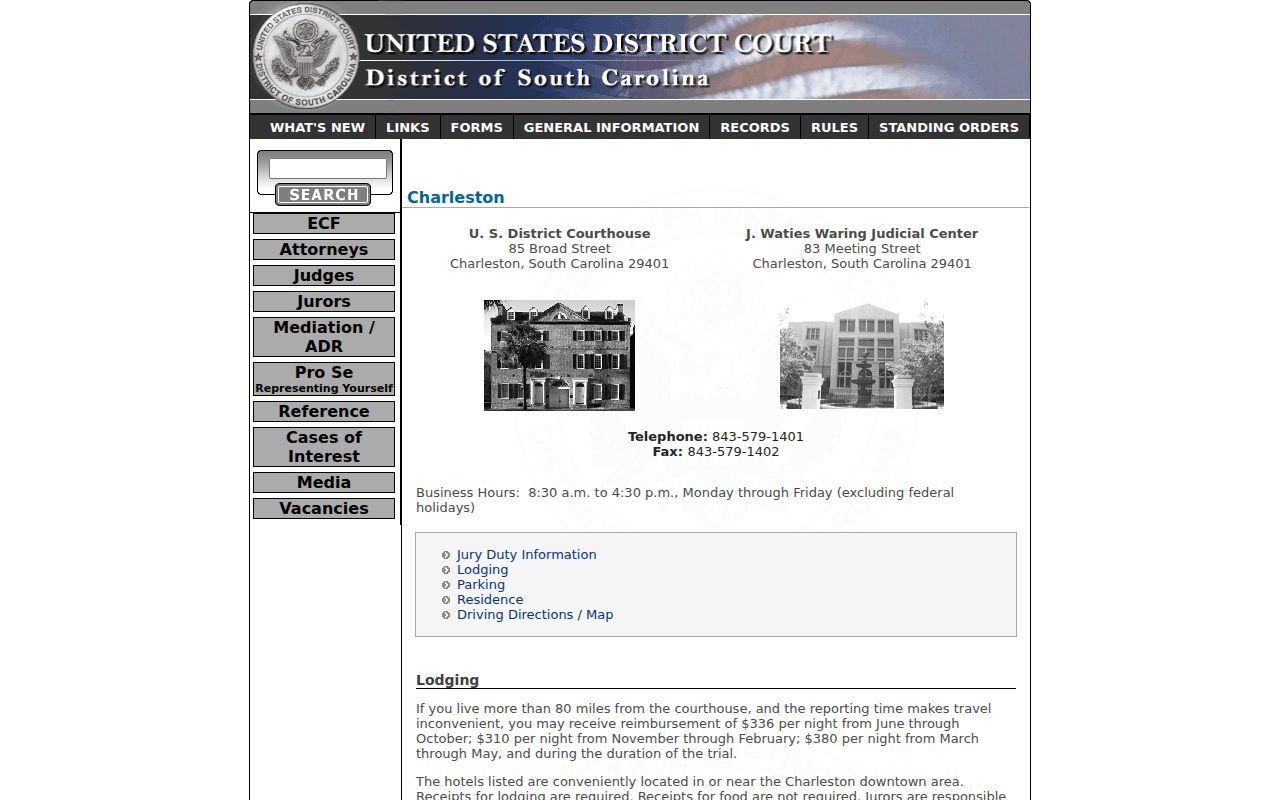
The Charleston courthouse page gives the federal court's location. Federal docket fees and coverage work separately from Berkeley County court access.
Berkeley County Arrest Records Have Limits
FOIA access depends on the record and its holder. South Carolina Code section 30-4-40 holds law-enforcement exemptions, while Court Rule 10 governs public court access with sealed and confidential exceptions. Juvenile records carry separate protections. Recent entries may lag online. Personal details may be redacted. Public Index can show a public case, not every current warrant event. The Berkeley County Sheriff's Records office handles Sheriff-held requests and the Clerk handles court files, so ask which record is held and whether a narrower or redacted response is available. South Carolina FOIA law and the court access rule explain those limits.