
How Bench Warrants Work in Berkeley County
South Carolina's official term is bench warrant. Even so, the trigger matters. The state keeps separate forms for a failure to appear, for trial in absentia, and for a bond-order violation involving electronic monitoring. The issuing court matters too. A municipal traffic case, a Magistrate summary matter, and a General Sessions setting do not share one record desk. In Berkeley County, Magistrate and Summary Courts handle traffic and summary criminal matters. Municipal Court takes town traffic, ordinance, and qualifying misdemeanor cases, while Family Court runs enforcement process tied to an underlying order. Berkeley County's Circuit Court General Sessions handles the serious criminal proceedings, and each issuing court controls its own next step.
Bench Warrant Issuance in Berkeley County
Missed court dates in Berkeley County take different forms, and the paperwork reflects that. The SCCA523 form is titled Bench Warrant after Failure to Appear. It captures the case, the missed appearance date, any bond or offense beneath it, and the judge's authorization, plus the officer's command and service return. Its 24-hour language is process instruction. It does not promise a hearing to the public. Two companion forms exist. SCCA522 covers trial in absentia, while SCCA525 addresses a bond-order violation tied to electronic monitoring. One missed date does not match every form, and a form's timing never sets a universal Berkeley County deadline. For a local contact, the Berkeley County Magistrate page sets out jurisdiction and official phone numbers.
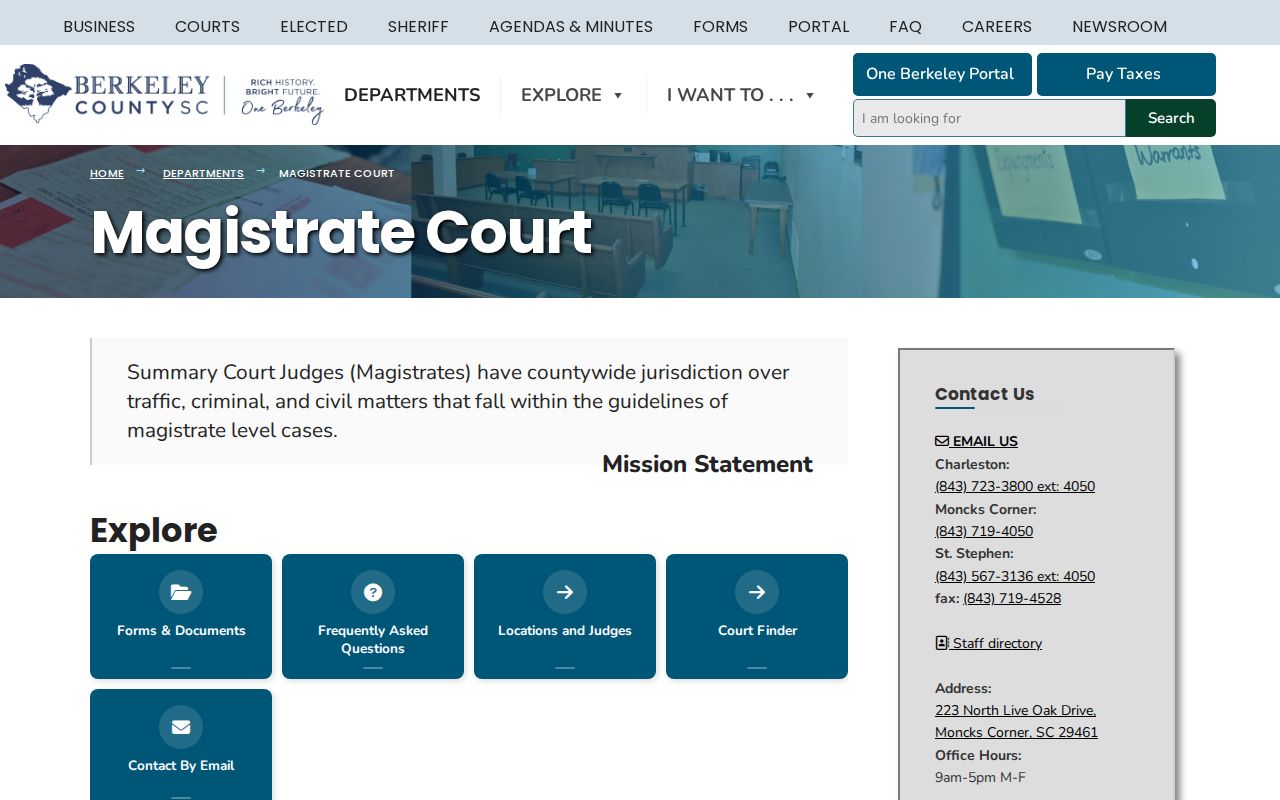
The Berkeley County Magistrate page describes court jurisdiction and official contacts. A clerk can route any case.
How Bench and Arrest Warrants Differ
A bench warrant grows out of a court event or order, usually a missed appearance. An arrest warrant follows a separate criminal process. A summons is different again. The label on your case paper, plus the court that issued it, tells you more than a general web search. South Carolina's forms separate the triggers, but they never disclose current case status. Ask the issuing court what it requires. It may want a motion, a new appearance, payment, bond, or another step. And a payment portal cannot by itself prove a Berkeley County court recalled its warrant.
| Process | Documented basis | Status contact |
|---|---|---|
| FTA bench warrant | Missed required appearance | Issuing clerk |
| Trial-in-absentia warrant | Separate form and court event | Issuing clerk |
| Arrest warrant | Authorized criminal process | Issuing court and serving agency |
| Traffic matter | Local payment or appearance issue | Municipal or Magistrate court |
Berkeley County Courts Issue Separate Process
Magistrate, General Sessions, Family, and Municipal Courts share no single bench-warrant list. Berkeley County's Clerk of Court keeps Circuit, General Sessions, Family Court, and bond records. Municipal and Magistrate clerks hold their own lower-court files. The Sheriff's Judicial Services division serves Magistrate bench warrants and other listed county process. Read the case number and court name first. Then use the Clerk or the county Magistrate page to find the right office. For a town citation, go to the issuing town court, or check the South Carolina Municipal Court directory, which lists Berkeley County area contacts.
Summerville Names a Warrant Division
Summerville's FAQ sends an outstanding town-warrant question to its Warrant Division. It also says employees cannot conduct active-warrant information. That route is town-specific. It is not a Berkeley County standard. The Municipal Court sits at a different listed address from the Police Special Operations contact, so confirm both before you appear. Missed a Summerville date? The FAQ says to call Municipal Court immediately. Its Motion to Reopen form asks for the case and charge, the hearing date, the officer or agency, and a factual basis. Other towns in Berkeley County may differ. Summerville's warrant FAQ gives the town route, and Special Operations describes service of municipal warrants and subpoenas.
Goose Creek Shows the Service Return
Goose Creek's police procedure offers one city-specific example of warrant service. The SOP describes a communications hold. It then covers identity verification, custody, service under Municipal Court procedure, an inactive marking after service, and a return to the city court. If service cannot happen at once, follow-up gets assigned. It is not a public lookup either. Nor is it a policy for every Berkeley County agency. The example does show why an internal active flag and a public case entry may not match. The court keeps the record, city police carry out service, and the officer returns the result, so current status still belongs with the issuing court or the responsible Berkeley County agency.
Goose Creek's Counts Are Historical
Goose Creek's 2020 annual report records 827 arrest warrants and 87 bench warrants served. Those are service counts. They cover one reporting year. Distinguish them from current outstanding cases, unique people, and any county totals you might be tempted to join them to. Do not mix the years either. The Berkeley County annual reports need the same care, because the 2020 figure counts warrants served while the 2021 and 2022 numbers measure entries. An old count never shows what is active today.
Reading the Berkeley County Bench Form
South Carolina's SCCA523 bench-warrant form is worth reading as a map of the process. Every box tells you something. The form records the county, the defendant, the case number, the date of the missed appearance, the offense or bond, and the judge. It lists the service jurisdiction, the command to the officer, and the officer's return. Some fields are different. Those can carry a date of birth, a home address, license data, or a Social Security number, which is why a filled copy never belongs on a public page. A blank Berkeley County bench warrant form explains the field categories and nothing more. No local warrant-number format is published.
| Case and date | Connect the order to the proceeding and missed appearance. |
|---|---|
| Judge and command | Shows court authority and the direction to an officer. |
| Service jurisdiction | Sets where process may be carried out. |
| Return | Reports action back to the court. |
| Private identifiers | Must be left out of public examples. |
Ask Before You Pay or Go In
No Berkeley County office publishes a flat recall fee, a standing bond schedule, or a set walk-in surrender rule. Call the issuing court first. Ask what process applies, what papers to bring, and how the court will confirm the action it takes. A lawyer can walk you through a motion, bond, an appearance, or surrender in a specific case. If the person is already in custody, Hill-Finklea detention staff can field booking and release questions, though only the issuing judge controls the warrant itself. One caution: a payment receipt or a blank online search does not prove a recall happened. File whatever written confirmation the court sends you.
Do not assume that paying a ticket or calling the jail changes a court's order. Confirm the required step with the issuing clerk.
Berkeley County Bench Warrants and Public Access
The Public Index can surface an eligible case, yet fresh entries often lag and sealed or confidential files stay hidden, with juvenile records under separate protections. Berkeley County FOIA requests run through exemptions too, and no request acts as a live warrant status check. Ask the clerk what record exists for the exact court file you need. South Carolina Code section 30-4-30 sets the public-record access rules, section 30-4-40 lists the exemptions, and Court Rule 10 governs court access. County-held records go through the county FOIA portal, while a town's own process handles city records. Read the South Carolina FOIA statute alongside the Rule 10 access rule.
Berkeley County Bench Warrant Next Steps
Before you dial, write down the court, the case number, the date, and the exact question. Ask whether a current bench-warrant entry exists, whether a motion or hearing is required, and how to get written confirmation once the required step is done. Don't ask a general office to guess which court owns the case. Berkeley County Magistrate direction is at 843-719-4050. Circuit or Family Court records sit with the Clerk at 843-719-4400, and Family Court answers at 843-719-4500. Sheriff service uses 843-719-4465, with Records at 843-719-4557. Each line has its own role.